Farang
Farang! Farang! The teen boys shouted as they passed by on the moped. The one riding on the back raised his arms with middle fingers extended from both fists. There was no malice in the gesture. They’d seen the hand motion in American movies, these boys with brown skin, dark eyes, and dark hair. And it was their first thought when they saw me, the boy with white skin, pale eyes, and pale hair. Farang. Foreigner.
The Thai aunties used to pinch my cheeks and touch my sister’s golden hair when we first moved to Thailand. I hated my cheeks pinched. Far more traumatic than leaving Texas and flying across the Pacific to Southeast Asia for me, a four-year-old. The strongest attachments I had were to my parents and my sister. These came with me. I didn’t think it strange my parents sold our climate-controlled suburban house in Stephenville, Texas and traded it for a traditional Thai house on stilts, uninsulated and reliant on shade and oscillating fans to beat the tropical heat that enveloped the town.
I quickly learned I drew attention in my new home of Nan, Thailand. At first, it was just stares. Maybe a shout of Farang! by an adult or child to get my attention so I would turn and they could get a better look at me, the oddity. I didn’t mind it. I liked being noticed at that age. And I liked to play. You didn’t need to understand each other linguistically for hide and seek, riding bikes, or shooting slingshots. But finding playmates took time.
We moved frequently, too. Every two to four years. One village to the next. Half a year or more at a mission house in the States. Everything was temporary. Always another move looming after settling into each new house. Another country and culture. My roots grew in a pot.
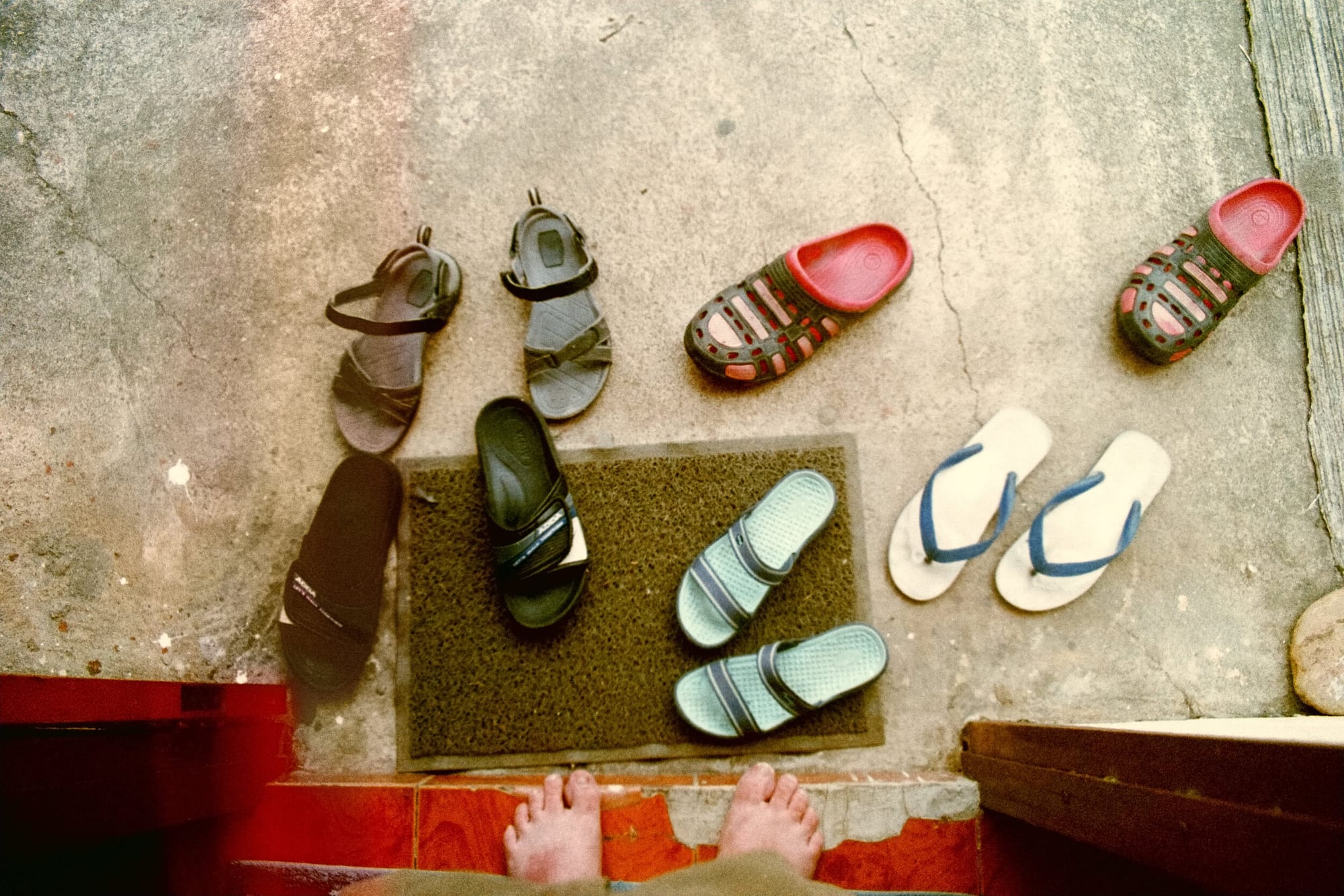
As I learned the language, I made friends. We’d build Legos on a mat laid out on the cement slab under our house. Play football in the lot next door, goals indicated by pairs of flip-flops. Fly kites on the dried-out rice paddies. Hold tournaments on the PS2--racing each other in Burnout or beating each other to a pulp in the latest Dragon Ball fighter. My language knowledge accommodated this and little more. What are we going to play? When are we going to play? Concrete, practical, superficial. I wasn’t interested in emotion or the abstract. So I didn’t learn it.
If I wanted to converse in my native language, my opportunities were slim. There were my parents and little sister, of course. But meeting other English speakers in the land of Thai was exciting to me. Rare. And almost never with a child my own age. So I learned how to play with adults and carry conversations with kids much younger than me.
My sister and I were homeschooled in the Northern Thai countryside among the rice paddies. International schools were an option, but Chiang Mai and Bangkok were five and ten-hour drives away, which meant boarding school. My parents didn’t want to send us away. I didn’t want to live apart from them either.
I had tastes of formal school, though. Semesters here and there. One in second grade at Chiang Mai International, another in fifth or sixth at Grace, once at a Texas public school. My favorite periods were recess and gym because this was a social rather than scholarly opportunity for me--being in a class with children all my age who spoke my language. An opportunity to be invited to birthdays, friends’ houses for playdates, to clown, to argue and fight, and make up.
And then I would leave.
I liked homeschool with its fluid schedule. Completing homework lying on the couch. Frequent field trips. Class on the go. The freedom to pursue my own interests. Generous time to read widely and deeply. But as I read novels with characters who had idealized friendships where they spent so much regular time together, I was reminded of the distant friends, acquaintances, I had who were living this--seeing the same faces every day, deepening relationships, becoming lifelong friends, developing crushes, discovering enemies, knowing and being known. And I felt envy. A yearning.
Most of my meaningful relationships had factors that created unavoidable distance: language, culture, age, location, time. In all cases, I was the odd one out. The homeschooler in a traditional class for a semester. The kid in a group of adults. The oldest in a gaggle of kids. The farang among my Thai neighbors. Only visiting.
--
I was so ready for college. Moving to the other side of the globe did not bother me. I had done it before. And I had a growing need to be able to think freely beyond the worldview of my parents. I desperately wanted to be surrounded by peers.
Where are you from?
Thailand.
Tyler, Texas! My cousin lives there.
I had this exchange during my first week in college. It encapsulated my experience reentering U.S. society in Texas. Anything foreign was mistaken, misheard, and immediately mapped to the familiar. I was easy to categorize in Thailand--you could just look at me. Here, I sounded and looked like one thing, but when it was discovered I was another, it often provoked frustration in people. Bewilderment at best. Maybe brief curiosity. I don’t watch American football. I don’t know the popular music. I didn’t go to prom. I didn’t grow up in the same church my whole life. I didn’t see my extended family regularly, or even on holidays. And once they knew all this, it was too much. Too much effort. And they would turn to more familiar things. Less foreign things.
I imagined myself an astronaut--a curiosity on any campus, in any town. Being asked the same questions, over and over, about space. Stirring some excitement, then indifference because you’re on the ground with the rest of us now. This is Earth. You can’t talk about the moon all the time. It’s way up there. It doesn’t have anything to do with us down here. Take off your suit and act like a terrestrial.
My sanctuary was the International Students Association. We all knew or were learning what it meant to be farang in the States. There was solidarity. A curiosity about each other’s language, culture, cuisine. But the craving of the familiar was here, too. Cliques pulled together by the gravity of shared nationalities. I was left adrift between orbits with a small handful of Third Culture Kids, individuals who grew up outside their parents’ passport culture. We spoke the same unmoored dialect. Shared the same regionless culture. We lived the same liminality. And we all knew this season--these relationships were temporary. The next move was imminent. We shared our depths first. We could enjoy superficialities later. When it was time to leave, there were no goodbyes. We had learned to only say, See you later, with a smile and dry eyes because if we crossed paths in the future, we could just pick up where we left off.
--
I did not expect Nashville to be long-term. I assumed it would just be the first stop after college. After a few years, I’d move to a bigger city or back to Texas. With any luck, I’d find a way to live in Thailand again. There, at least, I knew where I stood.
Four years passed. I got restless. Itchy. The rhythm that dictated my life said it was time to go. But all the old reasons were gone. There wasn’t a new village to evangelize, no furlough to the States, no college graduation.
So I stayed.
Another four years passed. Now I’m starting another. I discovered that I’m a homebody despite my childhood necessitating frequent travel and moves, and that I enjoyed my own company more than I thought, despite being starved of society most of my life. I found a new rhythm. My own. I thought of leaving often. Then less. And even less.
I became a better chameleon in Nashville, learning the expected patterns of a group and reflecting them back. These colors were true, even if they did not represent the full spectrum. The movie guy to movie friends, the photo guy to photo friends, the food guy to food friends. I had reconciled that most people could not or did not want to understand the rice paddies and how their hue changed with each season. That was too far away.
In all these circles, I feel like an interloper. The late addition. Last to arrive and likely first to leave. Wedging myself into a dynamic established eons ago. Tolerated. Possibly resented, because I’m temporary. I let my personality be big, but kept my demands small--thankful for the few kindnesses I received like a visitor in a stranger’s house. None of these places were mine after all.
I’m peripheral. This feeling is present even in my profession. I walk the edges of the events I photograph, observing. With my long zoom lens, I reach out and take what is offered--moments of laughter, earnest discussion, camaraderie, companionship. Then I move on. A momentary invasion of privacy, soon forgotten.
I found contentment in this. Why should my adulthood be any different from my childhood. But as my time in Nashville grew greater than the space I’d allotted it, suddenly I had friends I had known for a decade. Friends I’d seen marry, have children, buy houses. Friends who’d come and gone. Some told me I was a constant. And that, You have a lot of friends. But even surrounded by this network, I feel like a drop of oil immersed in so much water.
There are moments when I forget. I am in the living room with my friends. It is late. The light warm. Conversation flows and laughter is plentiful. I am lulled into belonging. I know these people completely. They know me. But then a comment is made. An innocent observation. About a common social or cultural experience everyone has shared. Except me. And I’m thrust outside. I stand in the darkened yard, resigned to watch through the amber window.
Leaving is my constant. Leaving Texas. Leaving Bangkok. Leaving Nan. Leaving Chiang Mai. Leaving Phrae. Leaving Thailand. Leaving Abilene. Me leaving, and people leaving me.
A friend who had left came back for a visit recently. It was a happy reunion. Quality time and catching up. And I started thinking of leaving again. What if I left this city? Left the indie theatre where I’d seen countless movies with friends, all the little bars with happy hours filled with stupid jokes and philosophy, the trails and parks hiked together. I imagined not being at my friend’s daughter’s next birthday party after attending every single one since her birth. Imagined no longer running into other regulars at the sake bar, no longer seeing my church community every week, no longer sharing early morning coffees before work, and so many precious little things that had become unconsciously constant…
And I began to weep.
 2025 Recs in Review
 Squeeze
 ๕
๕
 Mountain
 Foundation
 Basin
Basin
 Story
Story
 Advocate
 Dive
Dive
 Visions
 Below
Below